
Do the Hamstrings Work During a Back Squat? A Research‑Backed Look at Squat Biomechanics
For years, I’ve taught that the hamstrings contribute very little to the back squat from a biomechanical perspective. Many lifters assume the squat is a major hamstring exercise, but the research tells a very different story. When we break down joint mechanics, muscle function, and MRI‑based activation studies, the evidence consistently shows that the hamstrings remain largely quiet during the traditional back squat.
This article walks through the science behind that conclusion and highlights key research every coach, trainer, and kinesiology student should understand.
Why the Hamstrings Don’t Drive the Back Squat
The hamstrings perform two primary actions:
- Hip extension
- Knee flexion
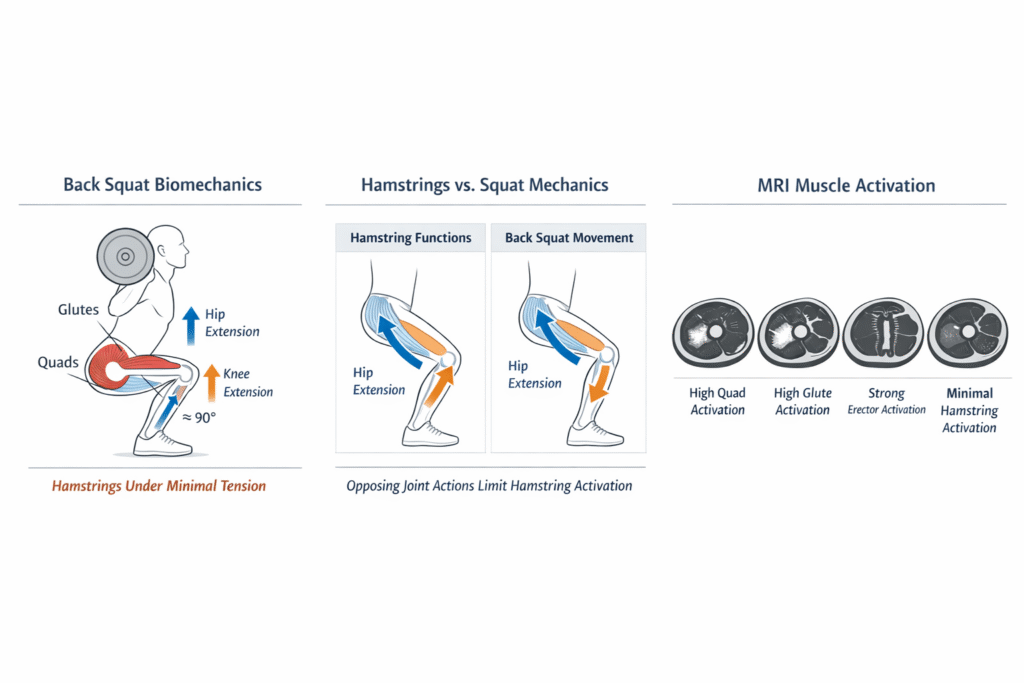
During a back squat, the hip extends but the knee extends at the same time. Because the hamstrings cross both joints, these two actions cancel out much of their potential force production. In other words, the hamstrings can’t generate meaningful tension when both joints move in opposite directions relative to their function.
This is why the glutes, quadriceps, and spinal erectors dominate the movement, while the hamstrings contribute minimally.
MRI Research: What Muscles Actually Fire During a Squat?
One of the most influential resources on this topic is the MRI‑based research published in:
Muscle Meets Magnet: A Revolutionary MRI Analysis of Muscle Use During Lifting
Per A. Tesch, PhD (1993)
Tesch’s work used MRI imaging to show which muscles experience the greatest metabolic activity during various lifts. When examining the back squat, the scans consistently highlighted:
- High activation in the quadriceps
- Strong involvement of the gluteus maximus
- Significant stabilization from the erector spinae
- Minimal activation in the hamstrings
This imaging aligns perfectly with what biomechanics predicts.
Additional Research Supporting Minimal Hamstring Activation
A wide range of peer‑reviewed studies reinforces the same conclusion.
- EMG studies show low hamstring activity compared to glutes and quads
- Hamstring activation increases only when the knee remains flexed (e.g., good mornings, RDLs)
- Squat variations with greater forward lean still do not significantly increase hamstring recruitment
- Exercises that lengthen the hamstrings under load—like RDLs, hip hinges, and Nordic curls—produce far higher activation
This is why the squat is a poor choice for hamstring hypertrophy or strength development, despite being an excellent lower‑body compound lift.
What This Means for Training Programs
If your goal is to strengthen or grow the hamstrings, the back squat simply won’t get the job done. Instead, prioritize:
- Romanian deadlifts
- Good mornings
- Hip hinges
- Glute‑ham raises
- Nordic hamstring curls
- Cable hip extensions
These exercises place the hamstrings under meaningful tension and align with their primary functions.
Want to Learn More About Biomechanics and Evidence‑Based Training?
If you’re building your expertise in kinesiology, strength training, or BCRPA certification, the KINESIOLOGISTS.CA Online Academy offers in‑depth courses that break down biomechanics, exercise prescription, and safe training progressions.
Consider taking: Fitness Theory, Weight Training, Personal Training, Older Adult Fitness or Group Fitness
These courses help you understand not just how to coach exercises, but why certain muscles work—and why others don’t.
Final Thoughts
The belief that the hamstrings play a major role in the back squat is one of the most persistent myths in strength training. But when we examine the biomechanics and the MRI‑based research, the conclusion is clear: the hamstrings contribute minimally to the movement.
Understanding this helps trainers design smarter programs, prevent injury, and choose exercises that truly target the muscles they intend to train.
A few other great articles:
- Isear Jr, J. A., Erickson, J. C., & Worrell, T. W. (1997). EMG analysis of lower extremity muscle recruitment patterns during an unloaded squat. Medicine & Science in Sports & Exercise, 29(4), 532.
- McCaw, S. T., & Melrose, D. R. (1999). Stance width and bar load effects on leg muscle activity during the parallel squat. Medicine & Science in Sports & Exercise, 31(3), 428.
- Escamilla, R. F., Fleisig, G. S., Zheng, N., Lander, J. E., Barrentine, S. W., Andrews, J. R., & Moorman, C. T. (2001). Effects of technique variations on knee biomechanics during the squat and leg press. Medicine & Science in Sports & Exercise, 33(9), 1552-1566.
- Manabe, Y., Shimada, K., & Ogata, M. (2007). Effect of slow movement and stretch-shortening cycle on lower extremity muscle activity and joint moments during squat. Journal of Sports Medicine and Physical Fitness, 47(1), 1-12.
- Paoli, A., Marcolin, G., & Petrone, N. (2009). The effect of stance width on the electromyographical activity of eight superficial thigh muscles during back squat with different bar loads. The Journal of Strength & Conditioning Research, 23(1), 246-250.
- Li, Y., Cao, C., & Chen, X. (2013). Similar Electromyographic Activities of Lower Limbs Between Squatting on a Reebok Core Board and Ground. The Journal of Strength & Conditioning Research, 27(5), 1349-1353.
- Aspe, R. R., & Swinton, P. A. (2014). Electromyographic and kinetic comparison of the back squat and overhead squat. The Journal of Strength & Conditioning Research, 28(10), 2827-2836.
- Yavuz, H. U., Erdağ, D., Amca, A. M., & Aritan, S. (2015). Kinematic and EMG activities during front and back squat variations in maximum loads. Journal of sports sciences, (ahead-of-print), 1-9.
- Contreras, B., Vigotsky, A. D., Schoenfeld, B. J., Beardsley, C., & Cronin, J. (2015). A Comparison of Gluteus Maximus, Biceps Femoris, and Vastus Lateralis EMG Amplitude in the Parallel, Full, and Front Squat Variations in Resistance Trained Females. Journal of applied biomechanics.