12 New Year’s resolutions to help you build a healthier business

The following information is from the this article (and for more details): Click here

1. Make financial projections for the coming year
2. Tune up your strategic plan
3. Set up an advisory board
4. Get up to speed on online marketing
5. Use more technology in your business
6. Review your sales targets
7. Get your business processes down on paper
8. Clean up your place of business
9. Learn to take your time when hiring
10. Introduce a performance management system
11. Schedule regular meetings with your key suppliers
12. Plan you days ahead

Posted in KINESIOLOGISTS.CA | Leave a comment

What is the upper limit of training volume for gains?

This is another great article by Menno Henselmans: Click Here >>

What is the upper limit of training volume for gains?

Menno’s take-home message:

  • Training to failure all the time is probably not a good idea.
  • Training a muscle only once a week doesn’t cut it for trained individuals with  higher volumes.
  • Muscle size does not seem to change the training volume dose-response relation. Smaller and bigger muscles thus probably have similar optimal training volumes.
  • When training to failure and performing all your weekly volume in one workout, doing more than 5-10 sets likely results in overreaching and sabotages your gains.
Posted in KINESIOLOGISTS.CA, Research | Leave a comment

BCRPA Group Fitness practicum hours FAQs

group fitness

Answers from BCRPA regarding the 8 practicum hours required for the group fitness certification prior to the Group Fitness ICE.  Here is a link to the BCRPA Scope of Practice documentation: Click Here

QUESTION: What style of class constitutes a BCRPA approved group fitness class  for obtaining credit for the 8 hours?  Would Zumba or a spin class count?

ANSWER: “Any class where the instructor is leading a group, so long as it falls within Scope of Practice, will qualify for the 8 hour practicum. I would be careful of teaching at Oxygen because hot classes are not covered under group liability insurance.” – BCRPA

QUESTION: Does a BCRPA certified Group Fitness instructor need to participate in the group class for the practicum hours to count?

ANSWER: “It isn’t as black and white as someone needing to be in the room, per se – if there is a supervisor in the facility who is aware that this person is teaching the class and is willing to vouch for them/step in should a safety issue arise, the hours will count.” – BCRPA

If you have more questions regarding the BCRPA Group Fitness course via the correspondence or classroom based versions, please give us a call or email as we would be glad to answer any and all of your questions.

Posted in KINESIOLOGISTS.CA | Leave a comment

Does ceasing exercise induce depressive symptoms?

A recent study in the Journal of Affective Disorders “Does ceasing exercise induce depressive symptoms? A systematic review of experimental trials including immunological and neurogenic markers” by Morgan, Julie A. et al. (Journal of Affective Disorders , Volume 234 , 180 – 192) found the following highlights:

  • No trials studied exercise cessation related depressive symptoms in depression.
  • Depressive symptoms were significantly higher in female participants than in male participants.
  • Depressive symptoms arose without changes in neurotrophic or immune biological markers.
  • High-quality trials in healthy adults and patients with depression are needed.

Talk to many who had to stop training and they will agree.  As much as regular exercise contributes to lowering depressive symptoms, stopping an exercise program may induce depressive symptoms.

So, remember this study the next time you are thinking about skipping your regular workout!

Link to study: jad-journal.com/article/S0165-0327(17)31749-4/abstract

Posted in KINESIOLOGISTS.CA | Leave a comment

Muscle growth and strength development – training muscles 6x vs. 3x per week!

Check out this study by Gomes et al. (2018) which found greater strength development and muscle growth when training each muscle 6 times per week compared to 3 times per week!   Although it was only an 8 week study, research showed the 6 times per week should better gains than the 3 times per week in the following 3 areas:

Increase in FAT FREE MASS (HYPERTROPHY)

    • 6 vs. 3 times per week  (+1.29% vs. +0.82%)

Increase in Strength – BENCH PRESS (1RM)

    • 6 vs. 3 times per week  (+9.64% vs. +5.41%)

Increase in Strength – BACK SQUAT (1RM)

    • 6 vs. 3 times per week  (+9.73% vs. +6.02%)

This is one of  infographic of the training schedule:

muscle growth

Full credit – this study was reviewed    and here is a link to the original PubMed article (Click here)


Posted in KINESIOLOGISTS.CA | Leave a comment

Hamstrings involved in Squats? Here is the research…

Do the Hamstrings Work During a Back Squat? A Research‑Backed Look at Squat Biomechanics

For years, I’ve taught that the hamstrings contribute very little to the back squat from a biomechanical perspective. Many lifters assume the squat is a major hamstring exercise, but the research tells a very different story. When we break down joint mechanics, muscle function, and MRI‑based activation studies, the evidence consistently shows that the hamstrings remain largely quiet during the traditional back squat.

This article walks through the science behind that conclusion and highlights key research every coach, trainer, and kinesiology student should understand.

Why the Hamstrings Don’t Drive the Back Squat

The hamstrings perform two primary actions:

  • Hip extension
  • Knee flexion

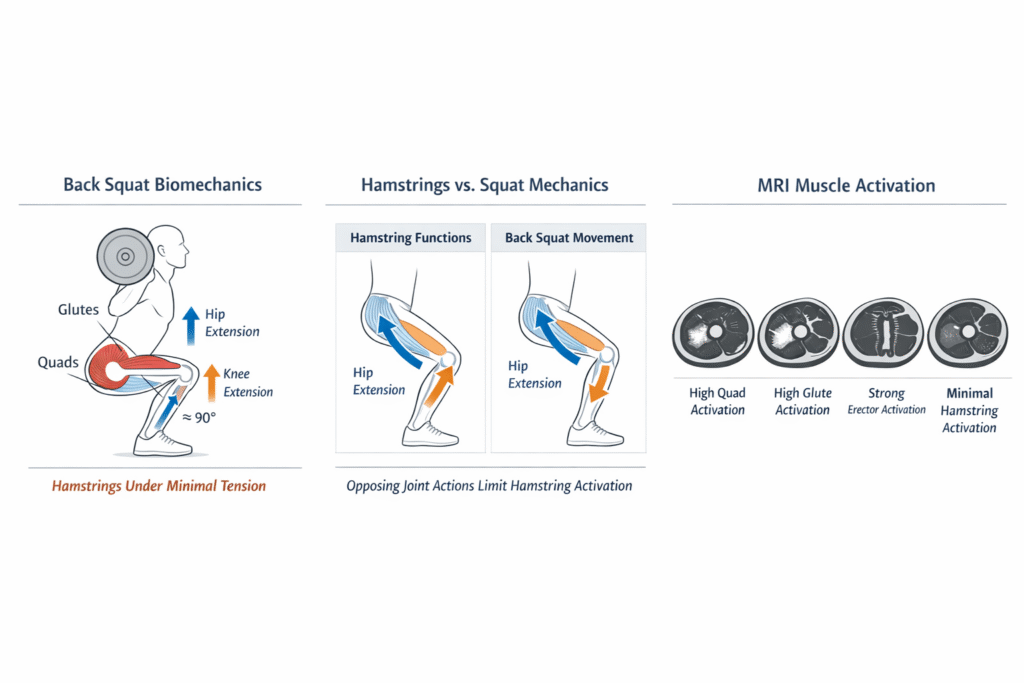
During a back squat, the hip extends but the knee extends at the same time. Because the hamstrings cross both joints, these two actions cancel out much of their potential force production. In other words, the hamstrings can’t generate meaningful tension when both joints move in opposite directions relative to their function.

This is why the glutes, quadriceps, and spinal erectors dominate the movement, while the hamstrings contribute minimally.
hamstrings during back squat

MRI Research: What Muscles Actually Fire During a Squat?

One of the most influential resources on this topic is the MRI‑based research published in:

Muscle Meets Magnet: A Revolutionary MRI Analysis of Muscle Use During Lifting
Per A. Tesch, PhD (1993)

Tesch’s work used MRI imaging to show which muscles experience the greatest metabolic activity during various lifts. When examining the back squat, the scans consistently highlighted:

  • High activation in the quadriceps
  • Strong involvement of the gluteus maximus
  • Significant stabilization from the erector spinae
  • Minimal activation in the hamstrings

This imaging aligns perfectly with what biomechanics predicts.


Additional Research Supporting Minimal Hamstring Activation

A wide range of peer‑reviewed studies reinforces the same conclusion.

  • EMG studies show low hamstring activity compared to glutes and quads
  • Hamstring activation increases only when the knee remains flexed (e.g., good mornings, RDLs)
  • Squat variations with greater forward lean still do not significantly increase hamstring recruitment
  • Exercises that lengthen the hamstrings under load—like RDLs, hip hinges, and Nordic curls—produce far higher activation

This is why the squat is a poor choice for hamstring hypertrophy or strength development, despite being an excellent lower‑body compound lift.


What This Means for Training Programs

If your goal is to strengthen or grow the hamstrings, the back squat simply won’t get the job done. Instead, prioritize:

  • Romanian deadlifts
  • Good mornings
  • Hip hinges
  • Glute‑ham raises
  • Nordic hamstring curls
  • Cable hip extensions

These exercises place the hamstrings under meaningful tension and align with their primary functions.


Want to Learn More About Biomechanics and Evidence‑Based Training?

If you’re building your expertise in kinesiology, strength training, or BCRPA certification, the KINESIOLOGISTS.CA Online Academy offers in‑depth courses that break down biomechanics, exercise prescription, and safe training progressions.

Consider taking: Fitness Theory, Weight Training, Personal Training, Older Adult Fitness or Group Fitness

These courses help you understand not just how to coach exercises, but why certain muscles work—and why others don’t.


Final Thoughts

The belief that the hamstrings play a major role in the back squat is one of the most persistent myths in strength training. But when we examine the biomechanics and the MRI‑based research, the conclusion is clear: the hamstrings contribute minimally to the movement.

Understanding this helps trainers design smarter programs, prevent injury, and choose exercises that truly target the muscles they intend to train.


A few other great articles:

  • Isear Jr, J. A., Erickson, J. C., & Worrell, T. W. (1997). EMG analysis of lower extremity muscle recruitment patterns during an unloaded squat. Medicine & Science in Sports & Exercise, 29(4), 532.
  • McCaw, S. T., & Melrose, D. R. (1999). Stance width and bar load effects on leg muscle activity during the parallel squat. Medicine & Science in Sports & Exercise, 31(3), 428.
  • Escamilla, R. F., Fleisig, G. S., Zheng, N., Lander, J. E., Barrentine, S. W., Andrews, J. R., & Moorman, C. T. (2001). Effects of technique variations on knee biomechanics during the squat and leg press. Medicine & Science in Sports & Exercise, 33(9), 1552-1566.
  • Manabe, Y., Shimada, K., & Ogata, M. (2007). Effect of slow movement and stretch-shortening cycle on lower extremity muscle activity and joint moments during squat. Journal of Sports Medicine and Physical Fitness, 47(1), 1-12.
  • Paoli, A., Marcolin, G., & Petrone, N. (2009). The effect of stance width on the electromyographical activity of eight superficial thigh muscles during back squat with different bar loads. The Journal of Strength & Conditioning Research, 23(1), 246-250.
  • Li, Y., Cao, C., & Chen, X. (2013). Similar Electromyographic Activities of Lower Limbs Between Squatting on a Reebok Core Board and Ground. The Journal of Strength & Conditioning Research, 27(5), 1349-1353.
  • Aspe, R. R., & Swinton, P. A. (2014). Electromyographic and kinetic comparison of the back squat and overhead squat. The Journal of Strength & Conditioning Research, 28(10), 2827-2836.
  • Yavuz, H. U., Erdağ, D., Amca, A. M., & Aritan, S. (2015). Kinematic and EMG activities during front and back squat variations in maximum loads. Journal of sports sciences, (ahead-of-print), 1-9.
  • Contreras, B., Vigotsky, A. D., Schoenfeld, B. J., Beardsley, C., & Cronin, J. (2015). A Comparison of Gluteus Maximus, Biceps Femoris, and Vastus Lateralis EMG Amplitude in the Parallel, Full, and Front Squat Variations in Resistance Trained Females. Journal of applied biomechanics.
Posted in KINESIOLOGISTS.CA | Leave a comment

Q & A – BCRPA Group Fitness ICE

BCRPA Group FitnessQUESTION:  A new BCRPA group fitness instructor, working at a local Rec Centre, was told the only person who could sign off on their 8 hour resume for group fitness was a BCRPA TFL.  The TFL would also need to be taking the class to provide full feedback.  Is this true? Any clarification would be greatly appreciated.

ANSWER (from BCRPA directly):  That’s a big nope – any instructor can sign off on the 8 hours. We recommend it be an instructor with enough experience that they can provide relevant and insightful feedback to their mentee – but that’s the only “requirement”.

Posted in KINESIOLOGISTS.CA | Leave a comment

Walking Speed Predicts Life Expectancy of Older Adults

Walking Speed Predicts Life Expectancy of Older Adults

Baby boomers who keep up the pace as they age are likely to outlive those who slow down.

This is a good read:  https://www.scientificamerican.com/article/walking-speed-survival/

And here are a few examples:

  • Grandma Hazel and I had a blast with the Senior Fitness Test yesterday, with the 8 foot up and go. The whole time I’m saying, “slow down, slow down” and she’s saying, “I thought this was a speed test.” “It is, but I don’t want you to fall.” She was all bummed because she did not make less than 60-year-old on 8 foot up and go, 2 minute step, and back scratch. I wanted her to quit the 2 minute step at 60 seconds. She went to 1:30 the first time, and insisted to repeat, and went to 2 minutes the 2nd time. She is hilarious. High stress for me.  “Is your boss going to be proud?”
  • For all the years that I worked at the hospital I ran – full out – from the parking lot to the hospital door. Many of the nurses laughed at me, and others asked why .”Because I can.”  Sprinting just seemed like something that people quit when they age. You probably have notice, I am not much for the weight lifting (only light weights) but I like to add a lot of balance and dynamics to my routines.
  • My 95-year-old Aunt Buddy use to move like the wind. I had to run to keep up with her. My sister use to say, “She beetles like a Farrier with that walker.” Grandma Hazel still uses Auntie Buddy’s walker today.”
  • My Aunt Emma was the oldest member in Western Canada at Curves at 97!  She walked both ways to the gym and participated 3 times per week.  During her 40 years in India teaching school, she never owned a car and walked everywhere!


Posted in KINESIOLOGISTS.CA | Leave a comment

BCRPA registration – recognized and/or transferable internationally?

Would you like to teach abroad or in another province?

BCRPA registration – recognized and/or transferable internationally?

Did you know that your BCRPA registration is recognized and transferable internationally through their affiliation with the National Fitness Leadership Alliance (NFLA) of Canada and the International Confederation of Registers for Exercise Professionals (ICREPs)?

No other provincial fitness body offers this unique benefit. The NFLA develops and implements national standards for fitness professionals across Canada which BCRPA fitness leaders abide by. These standards are recognized internationally through ICREPS’s global partnership of 10 Confederation Member countries around the world.

BCRPA, its national NFLA affiliates and affiliated ICREPs members are all governed under the same standards for fitness registration and practice. This means that your BCRPA registration is not only recognized in BC, but is transferable across Canada and internationally.

For further information, have a look at the NFLA and ICREPs websites.

Posted in KINESIOLOGISTS.CA | Leave a comment

Reliability of T-Spine Rotation ROM Measurements in Healthy Adults

Reliability of Thoracic Spine Rotation Range-of-Motion Measurements in Healthy Adults

. 2012 Jan-Feb; 47(1): 52–60.

https://www.ncbi.nlm.nih.gov/pmc/articles/PMC3418115/

Conclusions:

All techniques had good reliability and low levels of measurement error. The seated rotation, bar in front, and lumbar-locked rotation tests may be used reliably when more than 1 examiner is obtaining measurements (see below).

Posted in KINESIOLOGISTS.CA | Leave a comment